About
I love creating, even though I never received a formal art education. I have a secondary-school diploma, and perhaps it is precisely because I never studied art that the urge to create kept growing.
That inner drive, combind with not knowing how to create in a traditional way, pushed me to search for another way of making things, a way to calm the inner restlessness that came with my need to create. And now.. here I am, building a website and trying to share and sell what I have created.
I am shaping a world of images, searching for results that finally feel right to me. I wanted something within these images to become visible and recognisable, perhaps a face, or something that the mind could immediately connect with. That was something I absolutely wanted to achieve.
But often, the result became more than just one face. Faces appeared within faces, or one face seemed to shift into another perception of a face. What began as a search for something recognisable gradually started to develop into a theme of its own.
That is how pareidolia became part of my work.
And slowly, that inner restlessness begins to transform into a sense of inner calm and fulfilment.
My art itself is not magical. But the act of creating it is.
Making art feels healing to me. It is a process that transforms inner unrest into inner calm.
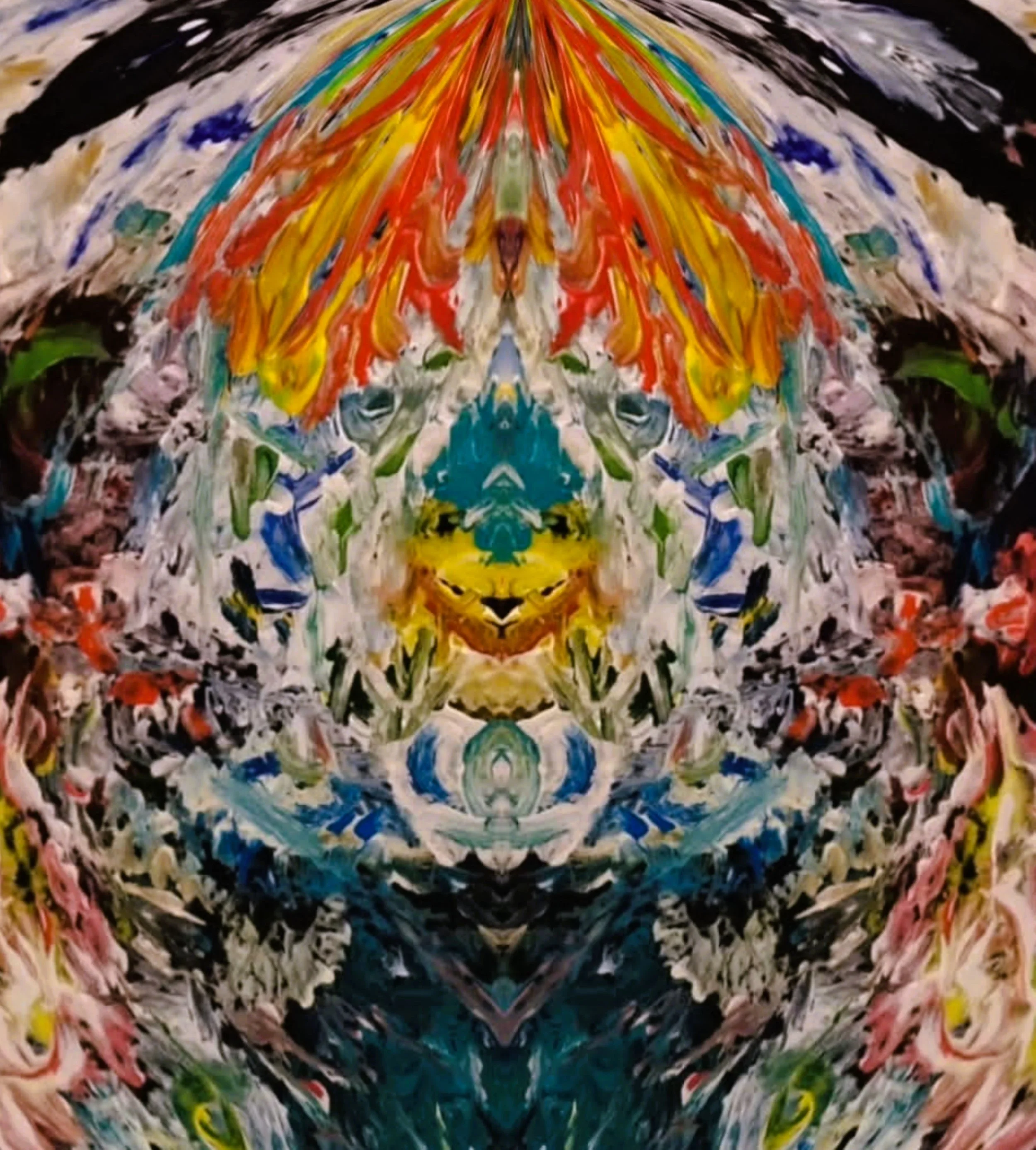
My artwork starts with hand-painted canvases. I photograph them and transform the images digitally. Through symmetry and shifts in color, figures emerge that I do not draw in the traditional sense. They appear on their own, shaped by textures and contrasts rather than by classical lines.
My work plays with pareidolia and with the idea that images reveal themselves slowly. Distance and time are essential to my approach to slow art. What you see can change, shift or reveal something entirely different when you take a closer look.
Rotate the work 180 degrees if you wish.
Art that looks back, in both directions.
How I Work With AI
I do not use AI to create my art — the images, textures, figures and transformations all come from my own hand‑painted canvases and the digital processes I apply myself. The creative act is entirely mine. But I do work with AI as a partner in reflection.
AI helps me evaluate my work, describe what is happening inside an image, and explore how viewers might perceive the figures that emerge. It allows me to test ideas, refine texts, and better understand the visual structures I build. In that sense, there is a collaboration — not in the creation of the artwork, but in the interpretation and development around it.
AI becomes a mirror, a second pair of eyes that sees patterns, connections, and possibilities I might overlook. It helps me articulate what my images evoke, without ever generating the art itself. The canvas, the paint, the symmetry, the transformations — that is my world. The dialogue about the work is where AI joins me.
Pareidolia
Pareidolia is the human tendency to perceive familiar forms or meaningful patterns in ambiguous or random visual information. Faces are perhaps the most familiar example: a cloud may resemble an animal, a piece of wood may appear to contain a profile, or a pattern in a wall may suddenly seem to look back at us.
The image itself may contain no intentional figure. Yet the mind detects something familiar within it and begins to give it meaning. What we see is therefore not determined by the image alone, but by an interaction between what is physically present and the way our brain interprets it.
Pareidolia can be found almost everywhere: in nature, architecture, everyday objects, reflections, stains, shadows and textures. It is not limited to vision either. People can also perceive meaningful sounds, such as voices or familiar patterns within ambiguous or noisy sounds.
The word pareidolia has a surprisingly long history. The German psychiatrist Karl Ludwig Kahlbaum introduced the term Pareidolie in 1866, in his work Die Sinnesdelirien. At that time, he used the term within a broader psychiatric context to describe particular forms of altered or illusory perception. The meaning of the word has changed over time, and today pareidolia is generally used to describe the perception of meaningful or familiar patterns in ambiguous stimuli.
Modern research has shown that face pareidolia is closely connected to the way our visual system detects faces. The brain appears to be highly sensitive to face-like features and can respond to an illusory face very rapidly. One neuroimaging study found that illusory faces initially produced a brain response more similar to real faces than to ordinary objects. Within roughly 250 milliseconds, however, this representation shifted and became more similar to the object itself.
But this does not mean that pareidolia simply switches off after a fraction of a second. The experience of seeing a face can persist beyond this initial neural response. Perception continues to develop as the brain combines visual information with interpretation, expectation and previous experience. Pareidolia therefore raises an intriguing question: where does seeing end and interpreting begin?
This question is central to my work.
I begin with hand-painted canvases and transform them digitally. Through symmetry, colour shifts, textures and contrasts, figures begin to emerge that I do not draw in the traditional sense. I look for something recognisable within the image, often a face, and then explore what happens when that recognition becomes unstable.
A face may contain another face. One face may shift into another. A figure may disappear when the image is rotated, only to reveal something else. What first appears to be one identity can become another through a change in distance, attention, colour or orientation.
This is where my work moves beyond simply finding faces in images. I am interested in the moment when perception begins to change.
How long does a figure remain pareidolia? When does a perceived face stop being merely something the mind has projected onto an image? And what happens when several people independently recognise the same figure?
Does shared recognition change anything?
Perhaps the figure is still pareidolia. Perhaps agreement between viewers only shows that our brains respond to the same visual cues. Or perhaps the boundary between what is physically present and what the mind contributes is not as clear as we might imagine.
I do not claim to have the answer. I am interested in exploring the question.
For me, pareidolia is therefore not simply about finding hidden faces. It is about the unstable space between seeing, recognising and interpreting.
And perhaps the most interesting question is not:
“Is the figure really there?”
but:
“At what point does the distinction between what is there and what we perceive become impossible to separate?”